
Why Does My Dog Eat Grass? Is It Normal?
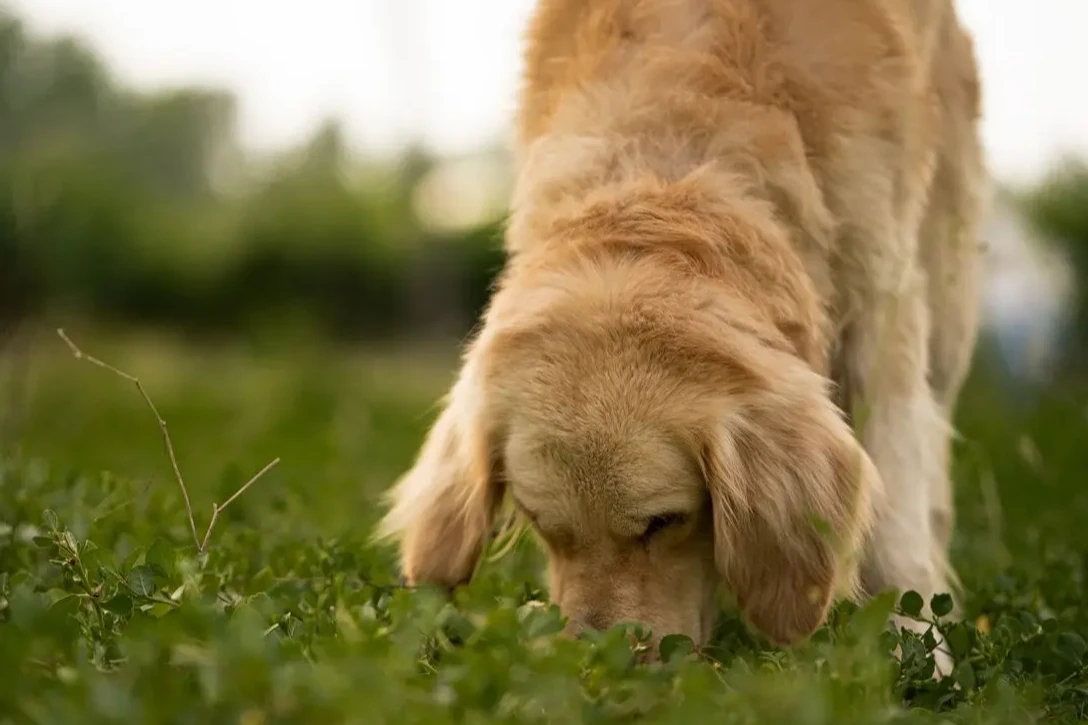
You open the back door, and within thirty seconds your dog has her nose buried in the lawn, pulling up mouthfuls like a small and very enthusiastic cow. If you have ever stood there thinking, why does my dog eat grass, you are in good company. It is one of the questions we hear most often at Lakeside Pet Hospital here in Santa Rosa.
The short answer is reassuring: grazing is normal canine behavior, and in most dogs it is not a sign that anything is wrong. The longer answer is more interesting, because the explanation almost everyone believes, that dogs eat grass to make themselves throw up, does not survive much contact with the research.
Is It Normal for Dogs to Eat Grass?
Yes, and it is common enough that it looks less like a quirk and more like a default setting.
The largest look at this behavior came from the University of California, Davis. Researchers surveyed the owners of 1,571 plant-eating dogs and found that 68 percent grazed daily or weekly, with grass the overwhelming favorite. In a separate group of 47 owners whose dogs had daily access to plants, 79 percent reported their dog ate grass or other greenery.
That same work found no meaningful connection between grass eating and a dog's sex, breed group, or the type of food in the bowl. Age was the factor that stood out. Younger dogs grazed more often, were less likely to appear unwell beforehand, and were less likely to vomit afterward.
The Upset Stomach Theory, and What the Evidence Actually Shows
Ask ten dog owners why dogs eat grass and nine will say it is to settle a sore stomach or trigger a vomit. It is a satisfying story. It also does not match the data very well.
In the UC Davis survey, only 9 percent of dogs regularly seemed ill before they started grazing, and only 22 percent regularly vomited afterward. For roughly three out of four grazing dogs, nothing comes back up at all.
A feeding trial at the University of New England in Australia approached the question from the opposite direction. Researchers used a fiber supplement to temporarily give a group of dogs loose stools, then offered them grass. The dogs ate less grass while their digestion was off, not more. Across 374 separate grazing episodes, the researchers recorded just two vomits. (McKenzie SJ, Brown WY, Price IR. Reduction in grass eating behaviours in the domestic dog, Canis familiaris, in response to a mild gastrointestinal disturbance. Applied Animal Behaviour Science, 2010.)
The takeaway is that vomiting seems to be an occasional side effect of grazing rather than its purpose. A dog who bolts a large mouthful of long, fibrous grass may well bring it back up, because those strands are irritating on the way down. That is a mechanical outcome, not a plan.
So Why Does My Dog Eat Grass?
If self-medication is not the main driver, what is? Several things, and your dog may be doing more than one of them.
- Inherited foraging behavior. Wild canids eat plant material too. The behavior survived domestication and generations of selective breeding, which suggests it serves some function even though we cannot yet name it precisely.
- Taste and texture. Many dogs are picky about which grass they want, seeking out tender new growth in spring and ignoring the same lawn in late summer. That pattern looks like a preference.
- Boredom. A dog left alone in a yard with nothing to do will invent something to do. Grazing is cheap, available entertainment.
- Learned attention seeking. If a mouthful of lawn reliably brings you across the yard calling your dog's name, the behavior gets rewarded every time.
- Appetite and routine. Some dogs graze most right before meals or while on a portion-controlled diet. This has not been established as a cause, but it is worth mentioning to your veterinarian if you notice the timing.
When Grass Eating Deserves a Closer Look
Normal grazing is casual and unremarkable. What matters clinically is change. Give us a call if you notice:
- Grazing that starts suddenly in a dog who never showed much interest before.
- Frantic, gulping grass eating rather than relaxed nibbling.
- Vomiting after most sessions, or repeated retching that brings up little or nothing
- Grazing paired with lip licking, drooling, hard swallowing, pacing, or a hunched posture
- Any of the above alongside diarrhea, reduced appetite, weight loss, or low energy
- A tight or swollen belly with unproductive retching, which is an emergency and needs care immediately
Cornell's Richard P. Riney Canine Health Center offers a practical benchmark: a one-off vomit following a grass session is usually nothing more than that, while vomiting as often as once a week can point to underlying disease. They recommend calling your veterinarian if you see blood in the vomit, anything that looks like coffee grounds, a painful belly, fever, low energy, or vomiting that runs past 24 hours.
In Sonoma County, the Grass Itself Is the Bigger Concern
For local dogs, the swallowed grass is rarely the problem. What is on the grass, and what the grass turns into by midsummer, matters far more.
Foxtails
Foxtails are the barbed seed heads that certain weeds and wild grasses produce, wild barley and millets among them, and they turn up everywhere in Northern California along trails, roadsides, fields, and the unwatered edges of backyards. UC Davis veterinarians explain that they are most dangerous once they dry and harden in the summer months. They usually enter through the nose, mouth, ears, and eyes, The barbs are angled so the seed travels in one direction only, which means it keeps working its way inward, causing abscesses and deep infections.
A dog who grazes with her face down in dry grass is exactly the dog who inhales one. Call us the same day if you see sudden repeated sneezing, head shaking, pawing at an ear or eye, squinting, swelling between the toes, or determined licking at one spot. Retrieval is far simpler when a foxtail is caught early.
Treated Lawns and Gardens
Researchers at Purdue University's College of Veterinary Medicine compared 83 Scottish Terriers who had developed bladder cancer against 83 other Scotties who had not. Dogs whose lawns or gardens had been treated with both herbicides and insecticides carried roughly seven times the odds of transitional cell carcinoma. Herbicides on their own carried closer to three and a half times the odds.
Two pieces of context matter here. Scottish Terriers already carry an unusually high baseline risk for this cancer, and Purdue is direct in saying the risk from lawn chemicals in other breeds has not been determined. Even so, if your dog is a dedicated grazer, it is worth knowing what goes onto your turf and keeping her off recently treated grass, whether it is yours or a neighbor's.
Parasites
Grass at parks, trailheads, and any shared green space can carry parasite eggs and larvae shed in other dogs' stool. That is one of the everyday arguments for year to year parasite prevention and for bringing a fecal sample to your dog's annual visit, particularly if she grazes on group walks.
Should You Stop Your Dog From Eating Grass?
For most dogs, no. A dog who feels well, eats well, is current on parasite prevention, and nibbles casually on a safe, untreated lawn is not doing anything that needs correcting. Suppressing a normal behavior for its own sake usually produces more frustration than benefit.
It makes sense to step in when the grazing is compulsive, when vomiting follows most sessions, when you cannot vouch for what is on the grass, or during foxtail season. A few things that help:
- Keep your dog leashed through dry, seedy areas and stick to paved paths and irrigated lawns in summer.
- Trim the hair between the toes and around the ears, and run your hands over ears, armpits, groin, and feet after every walk.
- Give the day more content: sniff walks, puzzle feeders, short training sessions, appropriate chews.
- Mow and irrigate regularly, and pull foxtail plants out of your own yard before they dry.
- Talk with us before changing diets on your own, since grazing on its own is not evidence that a food is lacking something
Frequently Asked Questions
Why does my dog eat grass and then throw up?
Usually because of how the grass went down rather than why it was eaten. Long strands swallowed quickly can irritate the throat and stomach. Most grazing dogs do not vomit at all, so an occasional episode in a dog who is otherwise bright and eating well is not alarming. Vomiting that happens most times, or roughly weekly, should be checked.
Is it OK for my dog to eat grass every day?
Daily grazing is common and, on untreated grass, generally fine. What we watch for is a change in intensity, grass eating paired with nausea signs, or grazing in areas with foxtails or recent chemical treatment.
Does eating grass mean my dog has worms?
Not by itself. Grazing is far too common to be a useful sign of parasites. That said, dogs who eat grass in shared outdoor spaces have more opportunity to pick parasites up, which is a good reason to keep prevention current and test stool annually.
Does grass eating mean my dog's food is missing something?
The UC Davis research found no association between diet type and how much dogs grazed. If your dog seems constantly hungry, is losing weight, or has changed her eating habits, those are worth an appointment, but grazing alone is not a reliable signal of a nutritional gap.
When should I call the vet about my dog eating grass?
Call when the behavior changes suddenly or becomes frantic, when vomiting or diarrhea joins it, when your dog seems off in energy or appetite, or when she has been in dry grass and starts sneezing, shaking her head, or licking one paw. A distended, painful belly with unproductive retching needs emergency care right away.
Talk With Our Team
Most grass eating is simply dogs being dogs. When it is not, the change is usually noticeable to the person who knows the dog best, which is you. If something about your dog's grazing feels different, or you have pulled a foxtail off her coat and want an experienced set of eyes on her, we are glad to help.
Lakeside Pet Hospital is a family-owned practice that has served Sonoma County for over 40 years. Call us at (707) 539-3393 or Request an appointment on our website.
References
- Sueda KLC, Hart BL, Cliff KD. Characterisation of plant eating in dogs. Applied Animal Behaviour Science, 2008. University of California, Davis. View record
- McKenzie SJ, Brown WY, Price IR. Reduction in grass eating behaviours in the domestic dog, Canis familiaris, in response to a mild gastrointestinal disturbance. Applied Animal Behaviour Science, 2010. University of New England, Australia.
- Cornell University College of Veterinary Medicine, Richard P. Riney Canine Health Center. Vomiting. View resource
- University of California, Davis School of Veterinary Medicine. Foxtails. View resource
- Glickman LT, Raghavan M, Knapp DW, Bonney PL, Dawson MH. Herbicide exposure and the risk of transitional cell carcinoma of the urinary bladder in Scottish Terriers. Journal of the American Veterinary Medical Association, 2004;224(8):1290-1297. Purdue University College of Veterinary Medicine. View research summary
Medically reviewed by: Deepa Sharma, DVM
This article is intended for general educational purposes and is not a substitute for individual veterinary advice. If you have concerns about your pet's health, please contact your veterinarian.